Halloween Murder Mystery Game Night: How to Host One at Home
Plan a Halloween murder mystery night at home: pick a case that fits the dark, put it on the TV, split the roles and run the evening. No box to order, no script to learn.
In this article
Halloween parties tend to go one of two ways. Either everyone stands around the kitchen in costume waiting for something to happen, or somebody has a plan. A murder mystery is the best plan there is: it gives the room one shared job, a little fear, a lot of arguing, and an ending where somebody finally gets to point at the screen and say it was her.
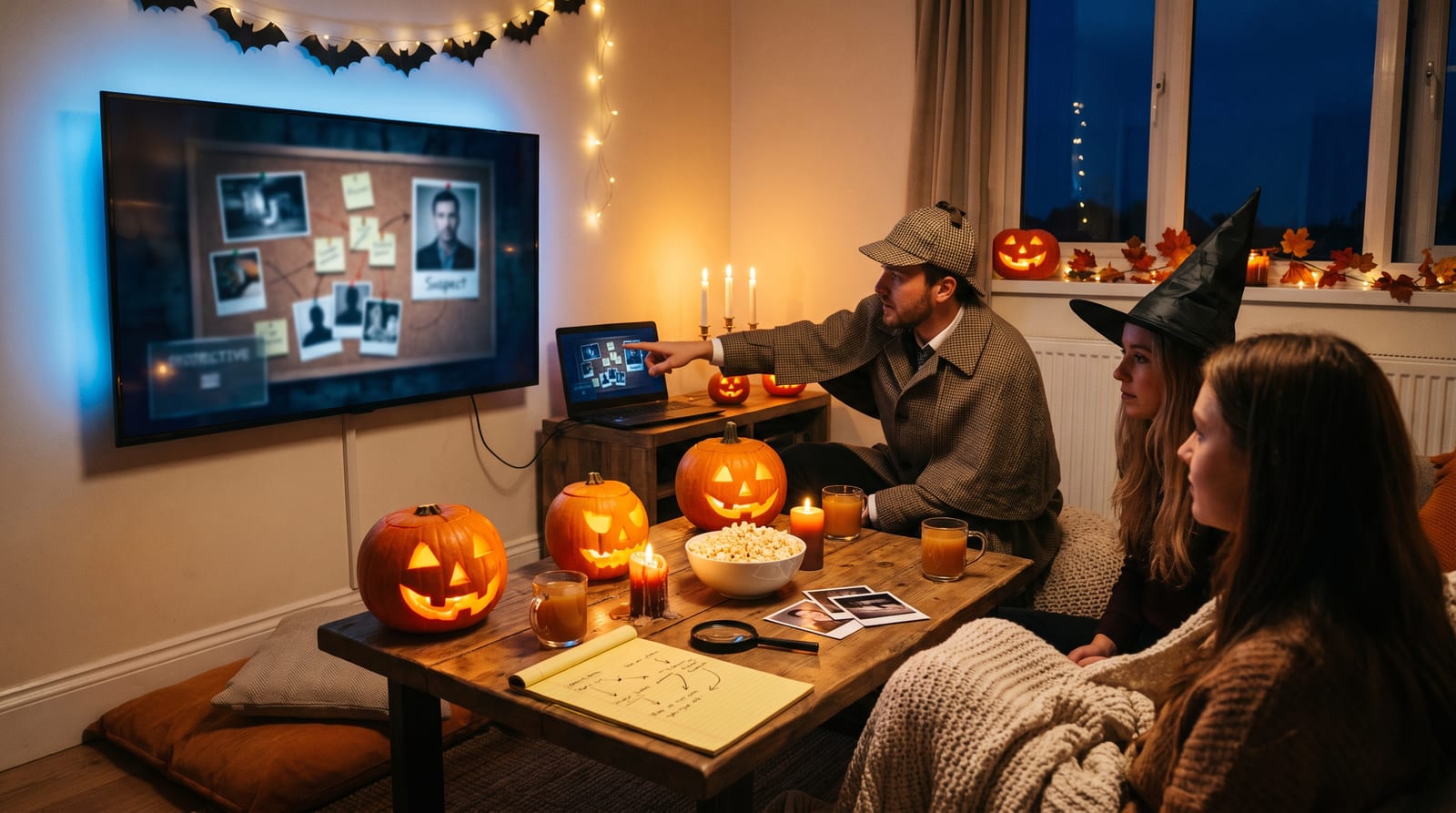
You don't need a boxed party kit, printed character booklets or a host who memorised a script. You need a TV, a laptop and a case. Here is how to run a Halloween murder mystery game night at home, from picking the case to the moment you name the killer.
Why a murder mystery is the perfect Halloween game
Most party games ask people to perform. Charades, improv murder parties where everyone plays a character: great for some groups, agony for others. A detective case works the other way round. Nobody has to act. The suspects, the lies and the evidence are already there, and the group's only job is to work out what really happened.
It also fits the night. Halloween is about the dark, the creak on the stairs and the thing you shouldn't have opened. A good case gives you all of that with a reason: a storm that cuts a castle off from the world, a lighthouse keeper's last radio call, a cabin door latched from the inside.
- Everyone plays at once. One person drives, everyone else reads, argues and spots things.
- Quiet guests get their moment. The person who barely spoke all night is often the one who notices the timestamp that breaks an alibi.
- It has an ending. You file charges, and the case tells you whether you were right.
What you need
- A laptop or desktop with a browser. DetectiveOS plays in the browser, nothing to install. Cases are made for a computer, not a phone.
- A TV and an HDMI cable (or screen casting), so the whole room can see the evidence.
- Two to six people. Bigger groups work too; split them into two teams on two laptops and race.
- An evening. A full case takes about one and a half to two and a half hours, and it saves as you go, so you can stop for food.
- Paper and pens. The game has its own notebook, but a big sheet of paper on the coffee table for a group timeline gets everyone involved.
One account is enough for the whole group. Sharing it with the friends you're solving with is allowed, so everyone can open the evidence on their own phone or laptop afterwards if they want to read along.
Pick a case that fits the dark
All eight DetectiveOS cases are murders or disappearances, but some fit Halloween better than others. These four have the most atmosphere.
The Wolf Feast: a castle cut off by a storm
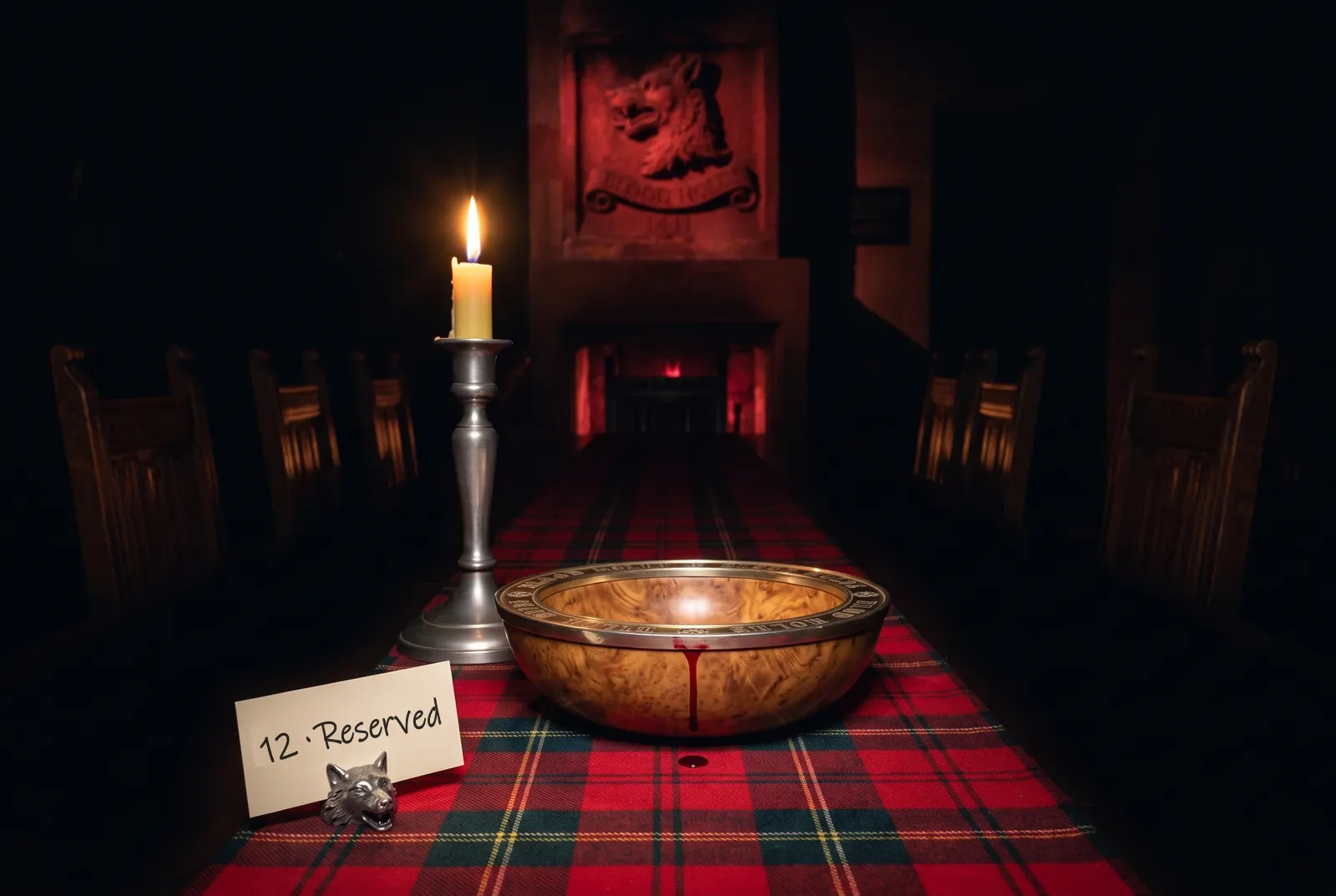
Twelve people drank from the same cup at a castle feast in the Scottish Highlands. Only one of them was meant to die. The road is closed by the storm and the press are already talking about a family curse. It is the best all-round Halloween pick: gothic, a big cast to argue about, and a medium difficulty that suits a mixed group. The Wolf Feast, about 2 hours.
The Lighthouse Signal: a keeper, a storm and a radio call
Minutes before the keeper fell to his death, someone sent a radio signal from his lighthouse. A storm, an isolated tower and a call nobody can explain. Also medium difficulty and one of the shorter cases. The Lighthouse Signal, about 1½ hours.
Last Train to Meridian: a locked cabin overnight
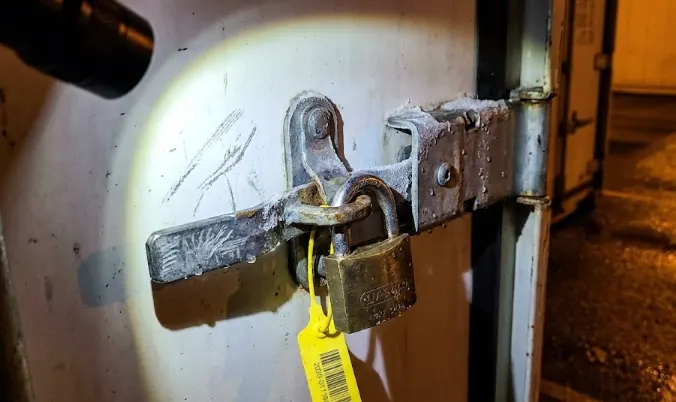
A man dies on a night train, in a cabin latched from the inside, and the crew insists it was medical. A classic locked-room mystery for a group that likes a challenge. Last Train to Meridian, expert, about 2½ hours.
Room 17: a door that locked a man in
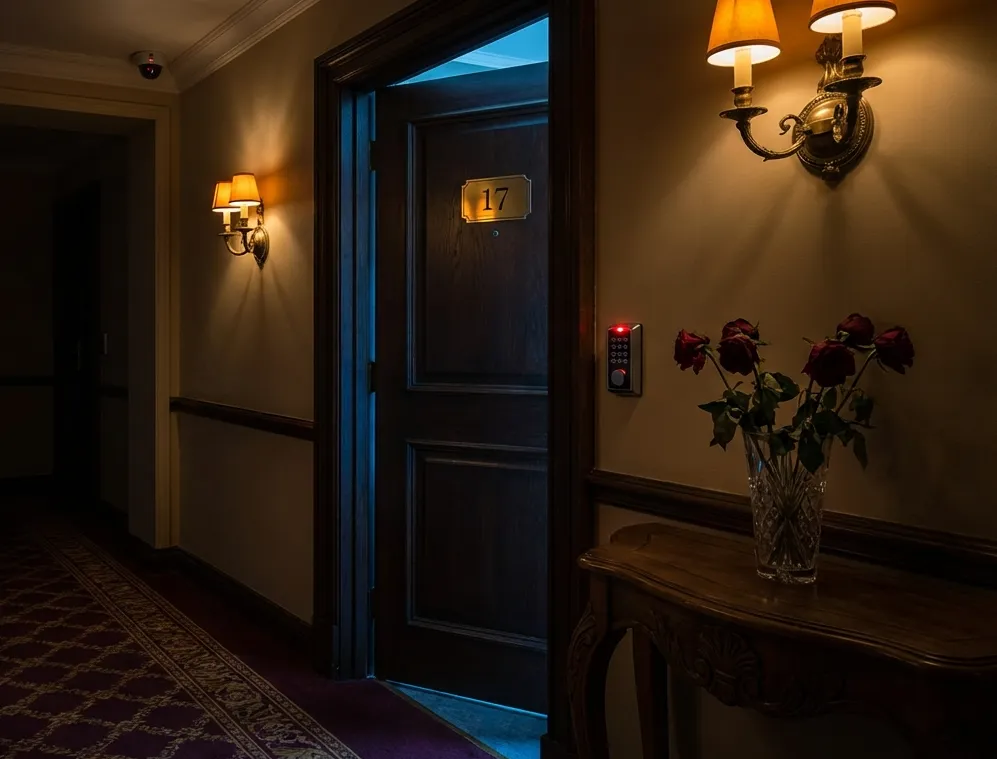
A hotel owner walked into Room 17 alone. Three minutes later, the door locked him in for good. Tight, clever and the hardest of the four. Room 17, expert, about 2 hours.
New to detective games, or not sure the group will like it? Start the night with Speak Now, the free case: a bride stabbed with her own wedding-cake knife before her midnight toast, four suspects and two lies to catch. It only needs a free account.
How to run the evening
A loose plan keeps the night moving without turning it into a schedule.
- Arrive and dress up. Give people half an hour to eat, drink and admire each other's costumes before anyone looks at a screen.
- Dim the lights and play the briefing. Every case opens with a briefing from the detective in charge. Read it out loud, or play it, with the room dark and the TV on. It sets the tone better than anything you could say.
- Meet the suspects. The briefing shows everyone involved. Let each guest pick a suspect they don't trust yet, and write the names down. Comparing hunches at the end is half the fun.
- Work the leads. The case gives you one lead at a time. Read the evidence together, then decide what to put on the lead. When a lead closes, that's a good moment for a snack break.
- Question the suspects. In the interview room you choose how to ask: straight, gently, hard, or with a bluff. When someone lies, call it out and show the evidence that proves it. Let a different guest run each interview.
- Vote before you file. When every lead is closed, the case asks for a charge: who did it, how, and which exhibits prove it. Have everyone say their answer out loud first, then file. Somebody will have been right all along, and they will not let you forget it.
Roles for a group of four to six
Giving people a job stops one person from playing while everyone else watches.
- The driver holds the laptop and clicks. Rotate every lead so nobody gets stuck there all night.
- The reader reads statements and emails out loud. Pick the person with the best spooky voice.
- The timeline keeper writes every time and place on the big sheet of paper. Most cases break on a timestamp.
- The skeptic has one job: to doubt everything a suspect says, and to ask "how do we know that?"
- The interrogator runs the interviews and decides when to press and when to bluff.
Costume and food ideas that fit the case
Dressing up as detectives is the obvious choice: trench coats, a deerstalker, a magnifying glass on a string. More fun is to dress for the case.
- For The Wolf Feast: tartan, candlelight and a Highland feast. Hot spiced cider or mulled apple juice in one big shared cup, for the brave.
- For The Lighthouse Signal: yellow raincoats, fishermen's jumpers and a big pot of chowder.
- For Last Train to Meridian: travel clothes from another decade, a dining-car menu and something in a small glass.
- For Room 17: hotel robes and slippers, a "do not disturb" sign on the bathroom door and room-service food.
Put a few props on the table: a torch, a notepad, an envelope marked "evidence". They cost nothing and people pick them up all night.
House rules that keep it fun
- No searching the answer online. Phones are for reading evidence, not for spoilers.
- Use the tips before anyone gets frustrated. Each lead has sealed tip envelopes that start with a gentle nudge. If the room has been stuck for fifteen minutes, open one. Nobody remembers who needed a tip; everyone remembers a dead half hour.
- Everyone speaks before the driver files anything. It keeps the loudest guest from solving it alone.
- Keep score if your group is competitive. A point for each lie caught, three for naming the killer before the charge is filed.
Playing over a video call
Friends in other cities can join. One person shares their screen on a video call and drives; everyone else reads along and shouts. Because sharing an account with the people you solve with is allowed, the others can also open the same case on their own computers to read the evidence in peace. It works surprisingly well: the case does the hosting, so nobody has to run the party.
If it's just the two of you, read our guide to murder mystery games for couples, and if you're used to boxed games, here is how DetectiveOS compares to Hunt A Killer and similar games.
Halloween murder mystery night: quick answers
How long does it take?
A full case takes about one and a half to two and a half hours. Plan a three-hour evening with food and breaks.
Is it too scary or gory?
No. The cases are crime stories told through statements, photos, messages and interviews. They are tense, not graphic, so they suit a Halloween crowd that likes atmosphere more than jump scares.
How much does it cost?
One case is $7.99, paid once, no subscription. All eight are $35.99, which covers a Halloween night and plenty of evenings after it. See pricing.
Do we need to prepare anything?
No. Unlike party kits, there are no character booklets to hand out and no host script. Open the case when the lights go down.
Ready to investigate?
Eight cases built like real police files.
Read the statements, check the evidence, question the suspects and name the killer. Plays in your browser, from $7.99, pay once.